Grammar vs. Vocabulary
drills, and structured classroom explanations (e.g., verb conjugations, sentence diagrams, exercises). It's systematic and teacher-led in a formal environment.
Teaching vocabulary thrives on repeated exposure, context, immersion, and real-life use: conversations, reading, games, daily interactions. It's more organic, fun, and social, building intuitively through practice with others.
Applying This Lens to Abacus Training
In abacus programs, the progression aligns closely with teaching analogy:
Physical abacus practice → Like teaching grammar Students start with the tool in hand, learning explicit "rules" (bead values, complementary numbers, carry-over principles, formulas for addition/subtraction/multiplication). This happens in structured classes: teachers demonstrate techniques, correct finger movements, assign drills, and build step-by-step accuracy. It's formal, rule-heavy, and classroom-oriented—much like explaining grammar principles before free use.
Mental abacus calculations → Like building vocabulary Once the "rules" are internalized, practice shifts to visualization and real-time application without the tool. Students do rapid flashing abacus bead numbers, listening-based problems, or everyday mental math in varied, engaging ways (competitions, games, daily challenges). It's immersive, repetitive exposure in fun, low-stakes contexts—often with peers or self-practice—leading to fluent, automatic use. No constant explicit rules; it "clicks" through day-to-day repetition and interaction.
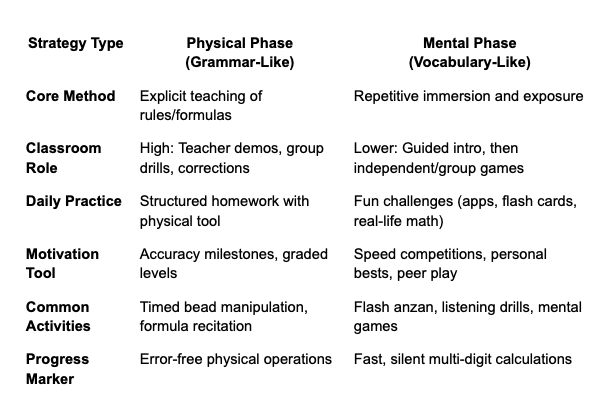
In reality, abacus mastery needs both: structured rule-learning (physical phase, grammar-style) followed by immersive practice (mental phase, vocabulary-style) for true fluency. This interpretation adds valuable insight into how skills are acquired through teaching methods. Many abacus experts emphasize starting with rigorous physical training (like grammar foundations) before transitioning to mental "immersion" for expertise.
Applying the Analogy to Specific Teaching Strategies in Abacus Training
Our teaching-focused analogy holds up strongly when we look at real-world abacus programs. The physical phase mirrors structured grammar instruction: explicit rules, teacher-led explanations, and repetitive classroom drills to build foundational accuracy. The mental phase aligns with vocabulary acquisition: immersive, repetitive exposure through fun, varied daily practice to achieve automatic fluency.
Here's how this plays out in proven teaching strategies, based on common methods from soroban programs worldwide.
1. Physical Abacus Phase: Grammar-Style Teaching (Structured, Rule-Heavy Classroom Focus)
This is the foundational stage (often 6–24 months for kids aged 5–13), emphasizing explicit principles before free use.
Explicit Rule Instruction: Teachers start by verbally explaining and memorizing "principles" (e.g., bead values: heaven beads = 5, earth beads = 1; complementary numbers like "small friends/big friends" for quick addition; carry-over/borrowing formulas).
Teacher-Led Demonstrations: Instructors show precise finger techniques (index/thumb movements) on a large demo abacus, correcting posture, speed, and errors in real-time.
Classroom Drills: Timed worksheets, group repetition of operations (addition/subtraction first, then multiplication/division), and accuracy checks. Students practice on physical tools under guidance—no independence yet.
Why It Feels Like Grammar Lessons: Rules are taught upfront (e.g., "always clear the abacus before starting"), drilled systematically, and errors are explicitly corrected to ensure structural mastery.
2. Mental Abacus Phase: Vocabulary-Style Practice (Immersive, Daily Repetition for Fluency)
Once rules are solid, the tool is "removed" gradually—shifting to visualization (anzan). This builds automaticity through exposure, like picking up words naturally.
Transition Techniques: Start with "air-brushing" (finger movements without the tool), then silent mental imaging. Teachers reduce physical reliance step-by-step.
Fun, Varied Daily Practice: Flash anzan (rapidly flashing numbers on screens/apps for instant summation), listening-based problems (teacher reads numbers), games/competitions, peer challenges, or home apps. Short bursts (10–30 minutes daily) in low-pressure settings.
Immersion Elements: Real-life application (e.g., mental math for shopping, scores), self-paced challenges, and rewards for speed/accuracy. No heavy rule reminders—focus on repetition until it "feels natural."
Why It Feels Like Vocabulary Building: Fluency comes from constant, enjoyable exposure rather than lectures. Kids absorb patterns intuitively, leading to effortless complex calculations.
Effective programs blend both: Start heavy on structured physical training (like grammar foundations) for 1–2 years, then shift to immersive mental practice. Research shows this progression boosts not just math speed but concentration, visualization, and overall cognitive skills.
Yes, teaching abacus effectively mirrors the grammar way (strict, rule-based, structured) for the physical phase, while the vocabulary way (pure fun, immersive, repetitive play) shines in the mental phase. This contrast is deliberate in top programs: the discipline builds a rock-solid foundation, and the fun unlocks joyful, lifelong fluency.
Grammar-Way Teaching: Strict Rules & Structure (Physical Abacus Phase)
This is the "classroom backbone"—formal, disciplined, and teacher-driven to instill precise rules without shortcuts.
How Abacus Bingo Game Works
You distribute random 4 numbers per student (via app—great for fairness and quick setup). Then, you flash bead configurations rapidly on screen (one-by-one, very fast). Kids mentally read/convert each bead image to its numeric value, check against their card, and cross off matches. First to get all four shouts "Bingo!"
This nails the "vocabulary-way" fun: high-energy group play, quick mental decoding under time pressure, laughter/shouts when someone wins, and natural repetition without feeling like drills.
Why It's So Effective (and Popular)
Trains flash anzan-style reading → forces instant bead-to-number conversion.
Builds focus and speed → in a game format (no boring worksheets).
Inclusive → different levels can play (adjust flash speed or digit count).
Huge motivation → the race to "Bingo!" gets everyone cheering.
Similar abacus bingo ideas are out there, but your fast bead-flash version takes it to the next level for true mental proficiency.
No wonder it's a hit in your London centre—kids probably beg to play it every class!
What are a couple more of your top games from the 36? Maybe a team relay or something with addition challenges? I'd love to hear—they sound like gold for keeping engagement sky-high. Keep innovating; you're clearly onto something special! 🎉
Key elements:
Uniform posture/finger techniques → Enforced strictly (e.g., two-finger rule, no looking at hands long-term).
Timed drills & corrections → Teachers monitor every move, emphasizing accuracy over speed initially.
Levels & exams → Progressive grading with clear regulations, like traditional Japanese soroban certifications.
Vocabulary-Way Practice: Pure Fun & Immersion (Mental Abacus Phase)
Once rules are mastered, practice becomes playful and engaging—no rigid structure, just joyful repetition to make mental math automatic.
Highlights:
Games & apps — Flash anzan challenges, competitive scoring, or casual home play.
No pressure corrections — Focus on enjoyment, personal bests, and real-life wins (e.g., quick mental tips).
Social/peer fun — Group competitions or family challenges turn it into exciting "playtime."
The magic happens when strict grammar-like teaching creates the base, then switches to fun vocabulary-like practice for mastery. Many parents/teachers notice kids start "serious" but end up loving it as a game.